
Civil Society Takes Its Seat at the AI Governance Table
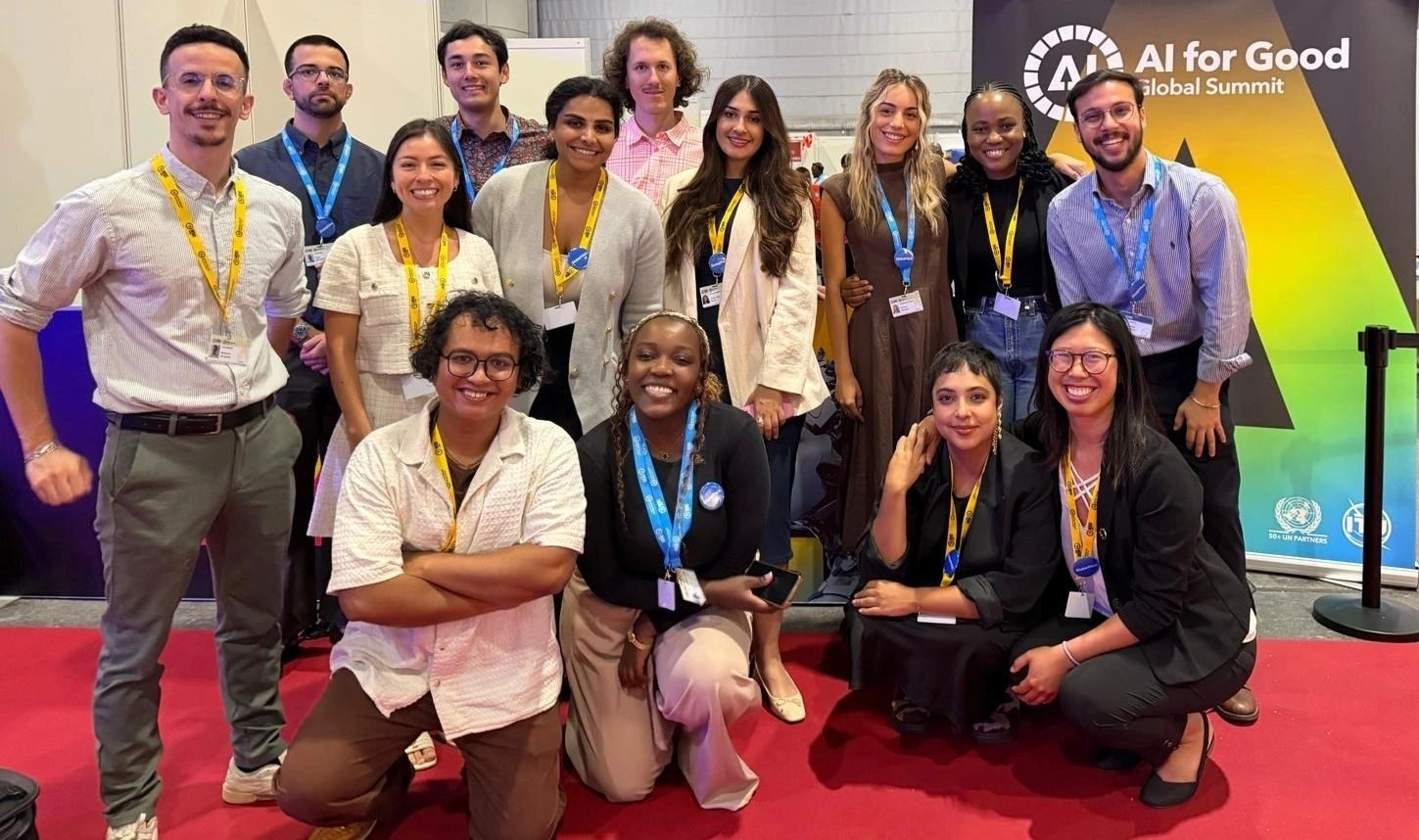
Geneva spent the week of 6-10 July hosting what may be the densest concentration of AI governance activity anywhere in the world: the WSIS Forum, the first UN-mandated Global Dialogue on AI Governance, and the AI for Good Global Summit, all within days of each other. Governments, international organisations, industry, academia, and civil society moved between the same rooms, often the same conversations, trying to answer one question: who gets to shape the future of AI, and how.
Globethics was present throughout, running its Emerging Leaders in Ethical AI Governance Fellowship residency alongside the official programme. Fourteen Fellows from around the world took part directly in panels, side events, and closed-door briefings, then carried what they heard back into their own work.
Whose Voice Counts
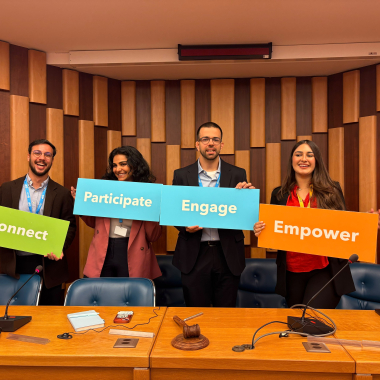
The week opened at the International Telecommunication Union with a WSIS panel on strengthening CSO and youth participation in AI governance, led by four Globethics Fellows: Pedro Maia, Emaan Yasin Malik, Addie Achan, and Vasileios Rovilos. Two points carried through the discussion. Inclusion of underrepresented voices, particularly young people, has to be authentic rather than performative, and decision-makers need to examine their own bias toward treating lived experience as the primary qualifier for a seat at the table, a bias that can just as easily exclude as include.
That afternoon, Fellows moved to the Globethics head office to hear from Dafna Feinholz, Chief of Section for Bioethics and Ethics of Science and Technology at UNESCO. Her message was direct: keep humanity and society's needs at the centre of AI governance work, treat diversity as a strength rather than a complication, and unite around a common good that serves people and planet together.
At the same time, Fellow Mohamed Alouane's organisation EuroMedAi co-convened a side event of the UN Global Dialogue on AI Governance entitled From AI Governance Evidence to Local Readiness: Prototyping Public-Interest AI Through Intercultural Dialogue.
Incentives, Not Just Intentions
Day two paired a session on AI ethics and meaningful CSO engagement, led by Globethics AI Ethics Manager Paola Gálvez Callirgos, with briefings from Julia Gray and Juan Iván Martín Lataix on AI, data science, and the future of work.
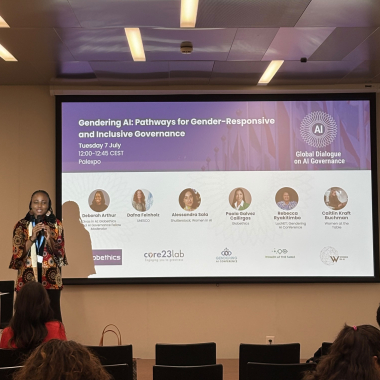
In parallel, Globethics held a side event at the UN Global Dialogue on AI Governance focused on gender and AI. Paola Gálvez, joined by Fellow Deborah Arthur, Alessandra Sala, Dafna Feinholz, Rebecca Ryakitimbo, and Caitlin Kraft-Buchman, pushed the conversation from principle toward mechanism. Paola pointed to incentives as the missing lever: gender considerations built into development bank loan conditions and private-sector procurement, paired with sustained capacity building that accounts for the heavier unpaid workloads many women carry at home.
Alessandra Sala argued that the field has enough discussion and not enough funding behind it: "You put money behind your words."
AI for Good: A First for Religious Perspectives
Midweek, Globethics and the Muslim Council of Elders co-hosted "AI as a Global Common Good: What Do Religious and Industry Leaders Think?" at AI for Good, the summit's first panel to bring religious insight into the AI governance conversation.
Chinmay Pandya opened with a warning against outsourcing life's decisions to machines, arguing that AI's growing power in healthcare, education, and governance raises the stakes on aligning it with human dignity and compassion, whatever tradition supplies the vocabulary. Industry voices grounded the discussion in practice. Alessandra Sala pointed to Shutterstock's model compensating artists for their IP in generative AI as an example of principle becoming product, while Dr. Rim Belhassine Cherif brought Tunisie Telecom's perspective on using AI to serve communities rather than only industry efficiency. Bryan Patrick Green cautioned against "ethical washing," urging companies to bring faith and spiritual voices in at the design stage rather than using them to validate technology after deployment.
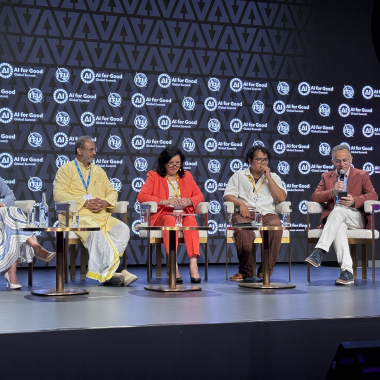
The standout moment came from Meem Arafat Manab, a Globethics Ethical AI Governance Fellow working on legal compliance for AI agents. Meem's research into what underlies law, beyond the laws that shift with every election, led to religion as a foundation of shared human understanding. Meem's challenge to the room, computer scientists especially, was to step outside their comfort zone: to "read some Gita and some Quran," because the future of AI interoperability runs through the frameworks that already shape people's sense of safety, dignity, and inclusion.
Geneva as a Global Centre for Implementation
Later in the week, Globethics' Fellows spent a morning on the État de Genève booth in Palexpo, sharing their various insights and discussing their projects with interested passersby, in between selfies with robots and attending the high-level panels on offer. Globethics was also proud to co-host a panel on the booth exploring Geneva's role as a global centre for inclusive and ethical AI, featuring Cecilia Cannon, Anne-Marie Buzatu, Dan Stein, Paola Gálvez Callirgos, and Kevin Osborne.
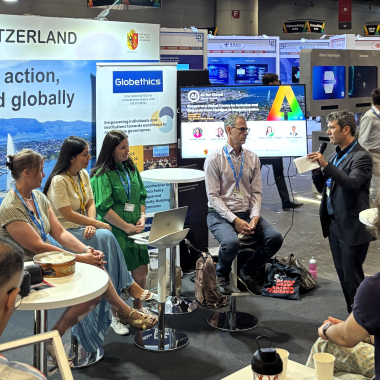
Dan Stein grounded the discussion in a practical reality: AI does not fix bad data. Most projects begin with a full review of an organization's data, and getting that data into shape is often the longest part of the journey, closely tied to change management and digital transformation. Paola Gálvez Callirgos pointed to Geneva's civil society ecosystem as already doing the work of widening the conversation, citing a Globethics-led consultation with fifteen civil society and academic organisations from Latin America and the Caribbean who could not travel to Geneva but whose input still reached the table.
Fellow Joel Christoph also spoke on AI and human rights alongside Joao Brant, Dr. Isabel Ebert, Jenna Omassi, Jacobo Castellanos, and Olivier Alais.
A Reception Built on Dialogue
Adding a more informal networking dimension to an already rich week, Globethics hosted a reception on Ethical AI Governance, bringing together diplomats, researchers, technology leaders, civil society representatives, foundations, faith leaders, and emerging AI practitioners. Remarks came from Fadi Daou, Dr. Chinmay Pandya, Stuart Russell, Amb. Prof. Muhammadou M.O. Kah, Eugenio V. Garcia, Joyce Nakatumba-Nabende, and Dr. Alessandra Sala. The evening was a reminder, in a week full of formal sessions, that effective AI governance is ultimately built through trust and relationships across sectors, not by any one stakeholder alone.
What the Fellows Take With Them
For several 2026 Fellows, the week was also a personal turning point. Addie Achan described AI as a potential leapfrog technology for people who lack access to information and resources, provided it comes with strict guardrails. Angela Ng questioned whether AI is really closing the gap it promises to close, or widening it, and pointed to the need to surface perspectives that training data leaves out. Chandrima Ganguly connected their fellowship project, on data literacy for non-literate communities in rural India, to a belief that empowerment to act has to start with empowerment to know. Arno Ratzinger, whose work is usually rooted in Switzerland, said the fellowship pushed his focus outward, geographically and professionally, giving him a rare three-month window to lead a project of his own.
A key takeaway for both the Fellows and the Globethics team was the fellowship's success in bringing young leaders from the Global Majority to Geneva, considering the importance of the discussions taking place. In the words of Fellow Nancy Muriithi: more than half of the world's AI governance conversations happen in Geneva, yet Africa faces some of the highest visa refusal rates for people trying to attend them. As Nancy put it, "How do you build global AI governance when parts of the world struggle to get into the room?" It is a question Globethics takes as seriously as any panel topic: inclusive governance requires not just an invitation, but the ability to walk through the door.
What Comes Next
The 2026 Fellows unpacked their takeaways from Geneva Digital Week in the July Open Track webinar, "AI and Society: Insights from AI for Good, WSIS Forum & the Global Dialogue," moderated by Paola Gálvez Callirgos, and conversations continue throughout the year at these open-access webinars. Globethics is also looking ahead to the Global Ethics Forum 2026 in Bali this October, and to the AI Impact Summit 2027, as the next milestones in turning this month's dialogue into ongoing, concrete collaboration.
Globethics' Emerging Leaders in Ethical AI Governance Fellowship supports early-career practitioners working on AI ethics and governance around the world.
You might also be interested in...
Reinventing Academic Integrity in the Age of Artificial Intelligence
Globethics nominated for WSIS Prizes 2026
Vote for the project Inclusive AI Governance in Action: Promoting Global Voices for Responsible Digital Transformation.
Journal of Ethics in Higher Education – Issue 8.2(2026)
Global experts map path forward for AI safety in Melbourne
Globethics chaired a global panel on AI safety at the International AI Cooperation and Governance Forum 2025 in Melbourne, Australia.