Landmark Global South Summit calls for democratic AI governance
The India AI Impact Summit 2026 concluded this past weekend as the first global AI summit hosted in the Global South — a symbolic and strategic milestone in the evolving conversation on AI governance.
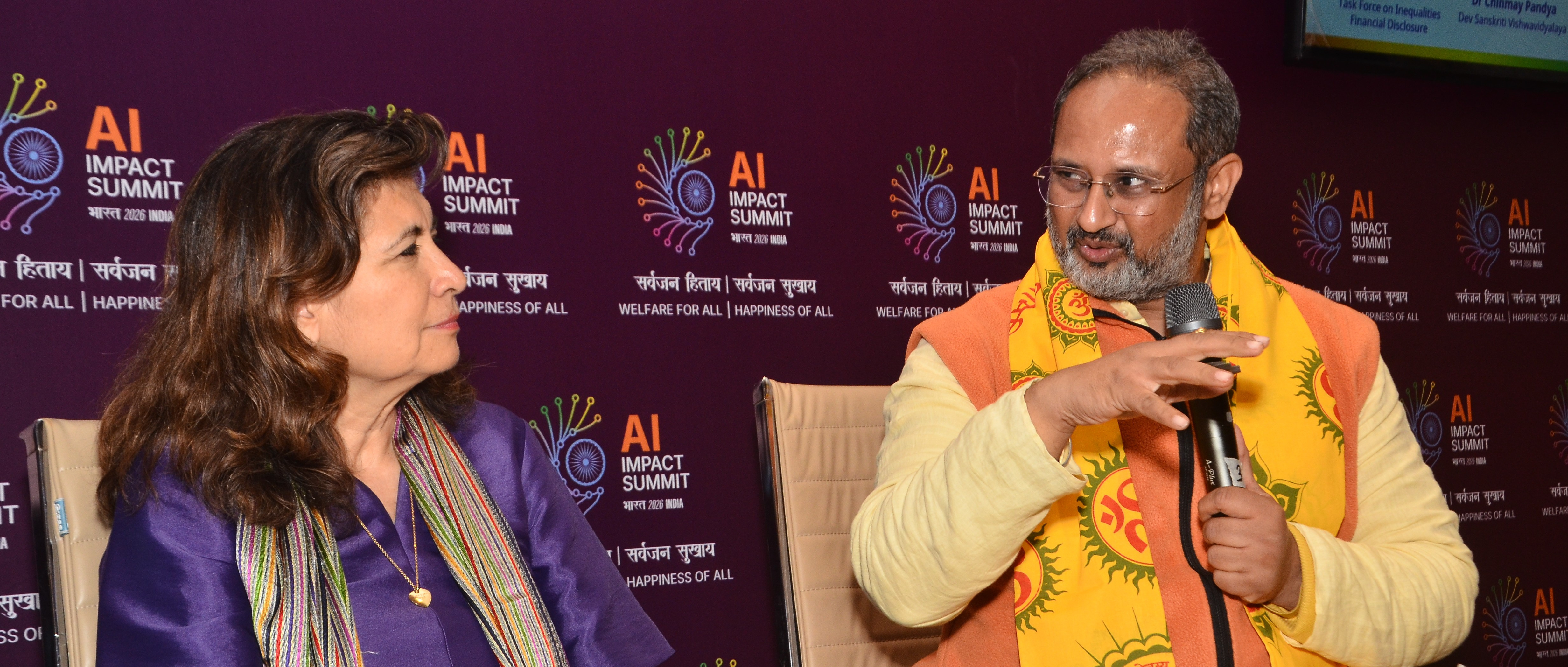
AI trust and safety emerged as one of the summit’s most prominent and widely discussed themes. Globethics contributed directly to this critical conversation through our dedicated roundtable on Trust as a Global Imperative: How to Operationalise Safe AI for All, reinforcing the urgency of enforceable safeguards and shared accountability. The session—which featured speakers Gabriela Ramos (Task Force on Inequalities Financial Disclosure. Former UNESCO/OECD), Marine Collins Ragnet (NYU’s Peace Research and Education Program), and Chinmay Pandya (Dev Sanskriti Vishwavidyalaya), and was moderated by our AI Ethics Manager, Paola Galvez Callirgos—encouraged conversation about democratising AI safety, ethics, and innovation beyond traditional Western power centres. Experts, students, government officials, and community leaders were invited to reflect on pressing questions of accountability, trust, safety, and accessibility in the age of AI.
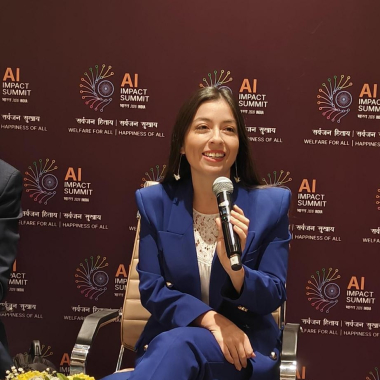
Paola challenged governments and industry leaders to move beyond voluntary principles toward participatory governance and enforceable safeguards. Democratising AI, she argued, requires not only access to tools, but also the power to shape how those tools are developed and deployed. For Paola, trust is built through inclusive governance structures that place affected communities at the centre of decision-making.
This trending discussion on AI safety and trust is echoed in Executive Director Fadi Daou’s recent blog, Safety vs Innovation, in which he explores the perspectives of Yoshua Bengio and Yann LeCun on the future of AI and argues for responsible innovation grounded in trust.
AI and democracy likewise stood out as a central thread across the Summit’s programme. Speaking on a high-level panel hosted by Dev Sanskriti Vishwavidyalaya, Fadi reimagined the technological frontier, arguing that it must introduce a new way of cultivating humanity’s intellectual, social, and ethical capital to build “a flourishing future for all” — a goal that can only be achieved with embedded safety systems and widespread digital literacy. For him, digital and AI literacy are no longer optional skills, but foundational components of human empowerment and democratic participation in the 21st century. During the panel on AI for Democracy: Reimagining Governance in the Age of Intelligence, he underscored the dual reality that challenges societies today: AI systems can strengthen democratic institutions through improved access to information and public services, yet they also pose risks of manipulation, disinformation, and erosion of critical thinking.
Informed by findings from the International AI Safety Report 2026—which identify malicious use, systemic labour disruption, and threats to human autonomy among the most urgent concerns—Fadi thanked India for returning the conversation to the purpose of AI: “social empowerment and participation of all people.” The discussion emphasised that safeguarding democracy requires embedding safety, transparency, and human oversight directly into AI systems, so that harm can be prevented and ethical success achieved.
Finally, digital empowerment and literacy remained foundational to many of the summit’s deliberations. When communities possess the literacy to understand AI systems, the agency to question them, and the protections to challenge misuse, technology becomes a driver of social good rather than a source of instability. Conversely, without safeguards, AI risks deepening inequality, concentrating power, and weakening public trust. Recognising that access alone is insufficient without understanding and agency, Globethics was pleased to co-organise a panel on digital literacy and empowerment with the Digital Empowerment Foundation. The session reinforced a shared conviction: equipping communities with the skills to critically engage with AI systems is essential to ensuring that technological advancement translates into social empowerment rather than exclusion.
The India summit demonstrated that conversations about AI governance are expanding geographically and conceptually. By foregrounding voices from the Global South, the gathering reframed innovation not merely as technological advancement, but instead as a collective ethical responsibility.
For Globethics, the path forward is clear: the future of AI must be democratic, safe, enforceable — and above all, centred on human dignity. These values will ground discussion and action at the next AI Impact Summit hosted in Geneva in 2027.
You might also be interested in...

Urgent call for strong international AI governance at ICCC 2025
The conference focused on the theme “Artificial Intelligence Ecosystem: Opportunities and Challenges”, aligning closely with Globethics’ mission on ethical AI governance.

Globethics at UNESCO Global Forum: Driving ethical AI
Globethics co-led AI ethics talks at UNESCO’s Global Forum, shaping global policy and championing women’s roles.

National Values in Vietnam and the World