
Safety vs Innovation? What Yoshua Bengio and Yann LeCun Teach Us About the Future of Artificial Intelligence
Fadi Daou, Globethics Executive Director, 20 February 2026.
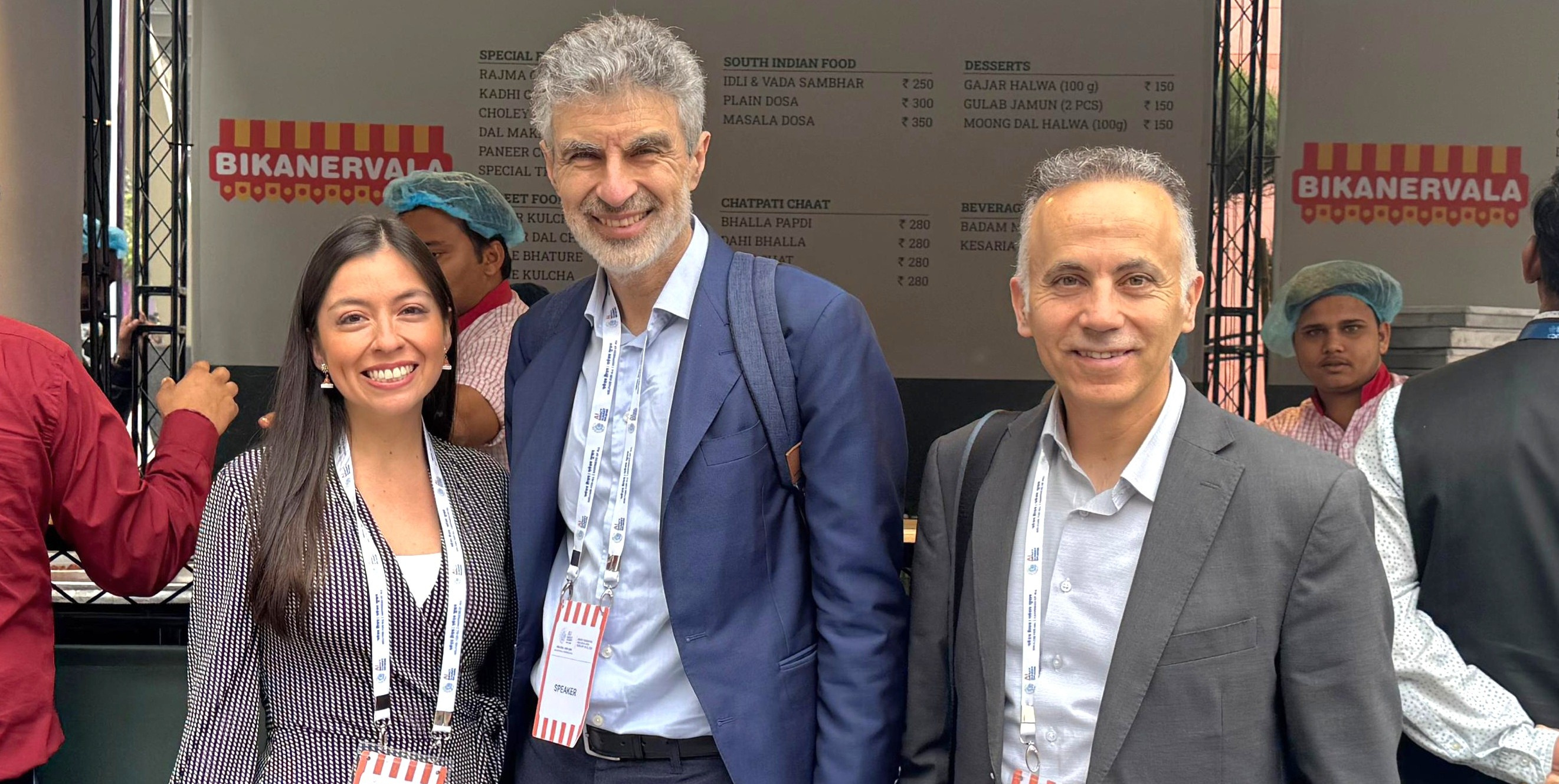
It is a privilege to discuss the future of Artificial Intelligence with two of its foundational architects: Yoshua Bengio and Yann LeCun — alongside Geoffrey Hinton, co-laureates of the Turing Award and pioneers of artificial neural networks and deep learning.
What makes the exchange particularly compelling is not their agreement — but their divergence.
At a time when AI systems are rapidly transforming economies, labour markets, education, and governance, understanding the balance between AI safety and AI innovation is no longer optional. It is a global priority.
The AI Risk Debate: Catastrophe or Controllability?
Yoshua Bengio, the most-cited living scientist across all fields and chair of the International AI Safety Report, expresses serious concerns about potential catastrophic consequences of advanced AI systems. His warnings centre on:
- The possibility that AI systems may outsmart human oversight
- The risks of open-sourcing powerful AI models
- The need for strong AI governance frameworks
- Substantial investment in AI safety research
In contrast, Yann LeCun adopts a more innovation-forward stance. He focuses on encouraging the development of AI systems that are transparent, controllable, and aligned with human values. His work on objective-driven AI seeks to embed safety directly into system architecture.
LeCun has argued that current large language models (LLMs) are still “dumber than a cat” and that scaling alone will not lead to human-level intelligence. His approach is not alarmist — but developmental.
Both perspectives shape today’s global AI governance debate.
The 2026 International AI Safety Report: 3 Risk Areas, 8 Direct Threats
A deep dive into the 2026 International AI Safety Report identifies three major risk categories and eight concrete threats that require attention:
Malicious Use of AI
- AI-generated content for criminal purposes
- Influence operations and manipulation
- Cyberattacks enhanced by AI systems
- Biological and chemical weaponisation risks
The report warns that advanced AI agents can now equal or surpass human-level performance in certain technical domains, including knowledge relevant to biological risks. This elevates AI governance from a digital policy issue to a global security priority.
AI Malfunctions and Loss of Control
- Reliability challenges
- Loss of control
As AI systems become more autonomous, ensuring controllability becomes central to responsible innovation.
Systemic Risks
- Labour market impacts
- Risks to human autonomy (weakening critical thinking and tendency to trust AI system outputs without sufficient scrutiny)
One of the most subtle yet profound risks is the erosion of critical thinking: the tendency to trust AI outputs without sufficient scrutiny. This affects democracy, education, and social cohesion.
Who Is Right — Yoshua or Yann?
Both. We need safety and innovation. We need governance and technological progress.
Bengio is right to call for stronger AI safety frameworks, regulatory oversight, and precaution. LeCun is right to pursue innovative system design with built-in safety mechanisms.
Framing this debate as a binary choice is itself misleading. The real challenge is integration.
The Real Risk: Governance Gaps and Lack of Global Dialogue
If there is something “wrong” in this debate, it is not either scientist. It is the lack of inclusive, multistakeholder dialogue and global governance mechanisms capable of representing humanity’s collective interests.
AI development is increasingly shaped by geopolitical competition, corporate concentration, and the pursuit of power and profit. The meta-risk behind AI is not only technical failure — it is the human craving for domination, control, and economic advantage.
Even if advanced AI systems were to cause harm, the accountable actors would remain human. Governance failures are human failures.
We must build the governance systems necessary to ensure that AI serves human dignity, sustainability, and peace — rather than amplifying division, instability, and inequality.