
Next-Gen AI in India: Ethics, Responsibility, and Sustainable Development
Key insights from Rajula Vethanayagam at the International Conference on Next-Gen AI and Emerging Technologies for Sustainable Development (IC-AIETS 2026), India. February 2026.
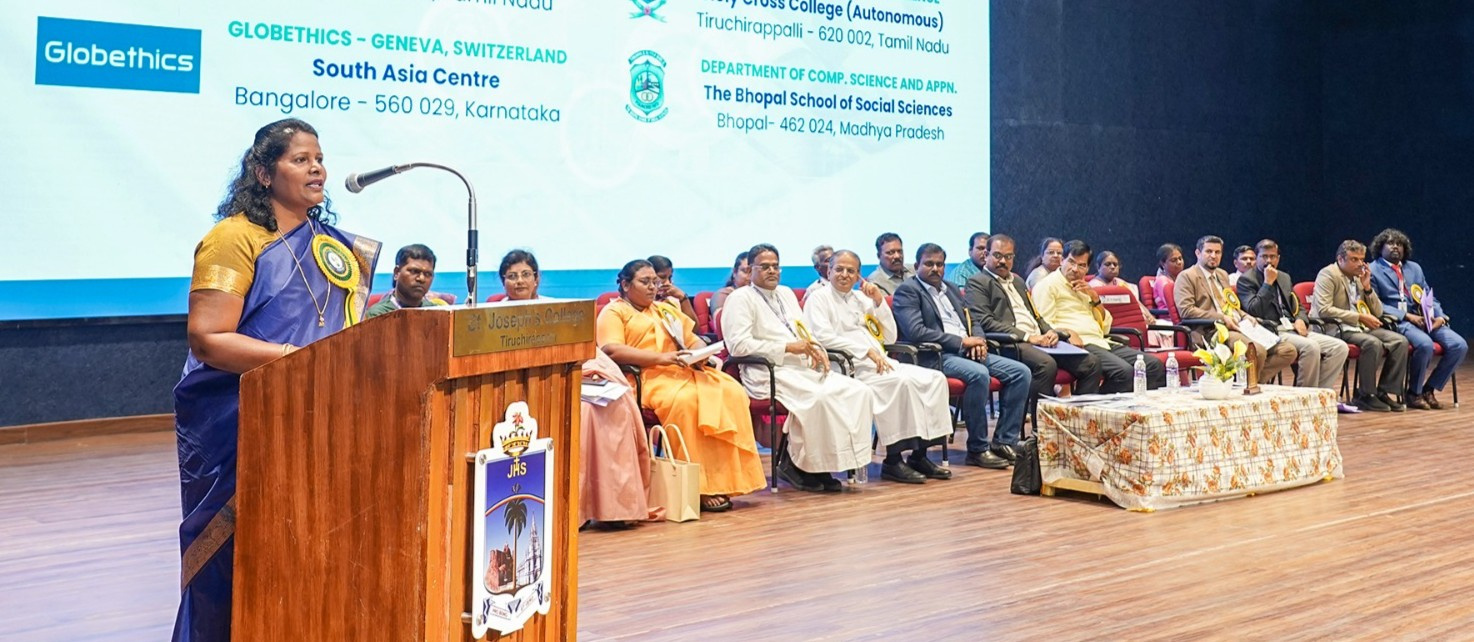
As India hosts the India AI Impact Summit 2026 this week, the conversation around Artificial Intelligence (AI) and emerging technologies has never been more timely — not just for innovation, but for ethics, inclusion, and sustainable development. Earlier this year, I had the privilege of participating in the International Conference on Next-Gen AI and Emerging Technologies for Sustainable Development (IC-AIETS 2026), held in Tiruchirappalli, Tamil Nadu, India.
Organised jointly by St. Joseph’s College (Autonomous), the Crossian Centre for AI Excellence at Holy Cross College, and The Bhopal School of Social Sciences, and in collaboration with Globethics South Asia, the conference brought together academicians, researchers, industry professionals, and students to explore the convergence of AI, ethics, and the UN Sustainable Development Goals (SDGs).
India’s AI Landscape: Promise and Responsibility
India is rapidly emerging as a hub for AI-driven innovation. From smart agriculture and renewable energy optimisation to digital healthcare and education technologies, AI is increasingly shaping critical sectors. But with opportunity comes responsibility. The conference made it clear that ethical frameworks, human-centred design, and governance cannot be afterthoughts—they must be embedded at the core of AI development in India.
As Regional Manager for Globethics South Asia, I delivered a session on:
- Ethical foundations of AI
- Human-centred and responsible AI frameworks
- Aligning AI with dignity, inclusion, and sustainability
- Integrating ethics into higher education and institutional governance
The discussion highlighted a key insight: in India, the challenge is not merely technical; it is moral, cultural, and social. Professionals and students alike are eager for practical, ethics-based approaches that enable innovation while safeguarding equity and social responsibility.
The Role of Policy and Higher Education
The Valedictory Session, graced by Dr Anbil Mahesh Poyyamozhi, Honourable Minister for School Education, Government of Tamil Nadu, underscored the policy dimension of responsible AI. His address emphasised:
- The responsible use of AI in education
- Integration of ethics, equity, and inclusiveness in digital transformation
- The critical role of higher education institutions in shaping socially responsible innovation
Such high-level engagement signals that India’s AI journey must align with values-driven governance, particularly in education and public sector initiatives. It also reflects a growing recognition that ethical leadership in technology is integral to sustainable development.
Key Takeaways from IC-AIETS 2026
- Responsible AI is a strategic imperative — not optional. Indian institutions must adopt ethical frameworks to guide research, innovation, and deployment.
- Human-centred AI frameworks are essential for equity, inclusion, and SDG-aligned development.
- Higher education is a critical driver — from curriculum design to faculty development, universities can cultivate ethically aware tech leaders.
- Collaboration matters — international partnerships, such as Globethics’ engagement, strengthen knowledge exchange and capacity-building.
- Future pathways include ethics-based academic programmes, policy-focused research, and institutional models of excellence in AI governance.
Building the Future: AI Ethics for Sustainable Development
India stands at an ethical crossroads in AI and emerging technologies. The IC-AIETS 2026 conference demonstrated that technological innovation and ethical responsibility must move hand in hand. By embedding ethics in design, education, and policy, India can lead not just in AI adoption, but in responsible, sustainable, and inclusive innovation.
As we reflect on the takeaways of the India AI Impact Summit 2026 this week, the message is clear: AI is more than a tool. It is a societal transformer. And to harness its full potential, India must champion ethical frameworks, human-centred innovation, and global partnerships that ensure emerging technologies truly serve sustainable development for all.