
Ethics Beyond Compliance: Why Responsible Governance Starts With Human Behaviour
Key insights from Kamel Ayadi, Globethics MENA Centre Regional Consul, at Global Ethics Forum 2025.
8 December 2025.
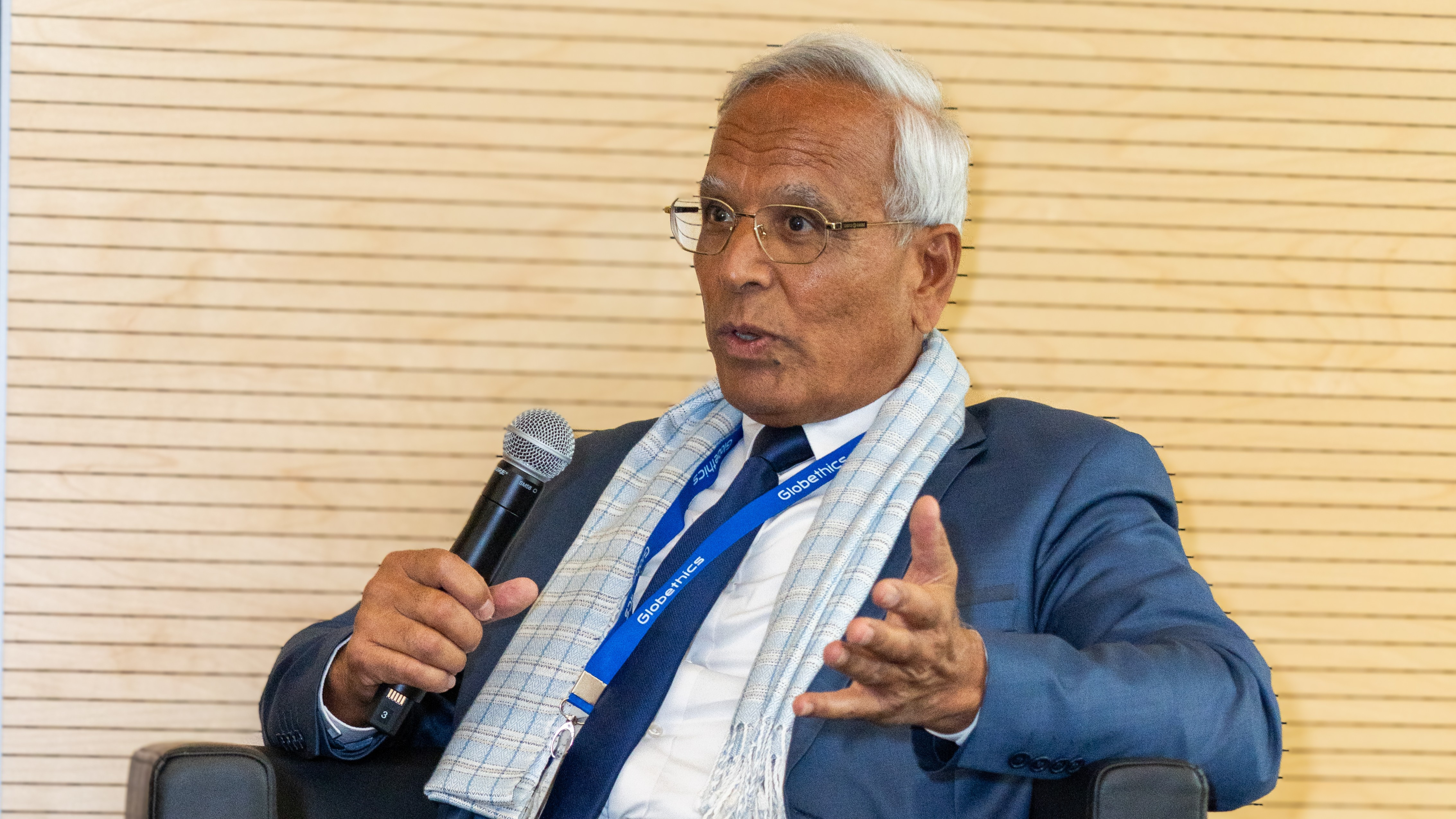
In today’s complex world, rules alone cannot ensure ethical governance. At the Global Ethics Forum 2025, Kamel Ayadi—international governance expert, former minister, consul for Globethics' MENA Centre, and contributor to ISO 37009—reminded leaders that ethics is more than compliance. It is a strategic capability that drives trust, accountability, and sustainable results.
Ayadi’s insights come from decades of experience leading global integrity initiatives, from engineering organisations to governments and international agencies. Early in his career, he realised that corruption cannot be defeated by rules alone. Excessive reliance on procedures can backfire: managers overloaded with compliance tasks may follow the rules without thinking critically, undermining initiative and ownership. The result is a culture where rules matter more than doing what is right.
Why Ethics Is More Than Anti-Corruption
Compliance systems and anti-corruption frameworks are essential, but incomplete without ethical foundations. “If we want to address corruption effectively,” Ayadi emphasised, “we need both hard measures and soft measures.” Hard measures—laws, controls, sanctions—set minimum standards. Soft measures—values, integrity, responsible leadership—set aspirations.
Ethics fills the gap between what rules can cover and what humans actually do. Rules can prohibit bribery, but they cannot build courage. They can mandate disclosure, but not honesty. They can define responsibilities, but not accountability. Ethics is the operating system that makes compliance meaningful rather than mechanical.
Ethics in Action: Building Global Anti-Corruption Capacity
Ayadi’s work brings ethics into tangible, global initiatives. A prime example is the Preventing and Investigating Corruption Anti-Corruption Train-the-Trainer (TTT) Programme, co-led by Ayadi and experts from the Global Infrastructure Anti-Corruption Centre (GIACC) and the World Federation of Engineering Organizations—Committee on Anti-Corruption (WFEO-CAC).
The programme, concluded earlier this year, equipped 149 professionals from 43 countries – spanning engineering, academia, NGOs, law, public service, and professional institutions – with practical tools, knowledge, and skills to promote integrity, detect and investigate corruption, and train others to do the same.
The training covered four comprehensive suites: corruption prevention and investigation in procurement and construction, best practices in detection, corruption measurement and alternative metrics, ethics, AI, and conflict-of-interest frameworks. A multi-format approach—presentations, expert panels, case studies, moderated discussions, online polls, and evaluation surveys—ensured both engagement and practical learning. Feedback confirmed its impact: 98% found it professionally useful, and 97% intended to apply the knowledge in their contexts. This initiative exemplifies how ethical training can extend well beyond compliance, building real-world capacity for integrity and transparency.
Ethics as a Source of Hope, Not Constraint
What stood out in Ayadi’s remarks at the Forum was his insistence on hope. Despite global tensions, technological disruption, and a “race for AI supremacy,” he sees growing public awareness as a sign of promise. Civil society, thought leaders, and organisations such as Globethics are bringing ethics to the centre of debates on technology and governance. Awareness, he argued, is rising faster than the risks themselves—an encouraging shift.
He sees hope, too, in regions like MENA and Africa, where the youth population hold enormous potential. Yet he warns that this potential can only be fully realised to the benefit of those regions if their governance systems are trustworthy, fair, and grounded in integrity—conditions that stem directly from ethical leadership.
Ayadi’s final insight is perhaps the most counterintuitive: ethics is efficient. When people act with integrity, organisations achieve better results with fewer rules. Trust accelerates decisions. Transparency reduces friction. Responsible behaviour lowers the cost of oversight. In other words, ethics is not a moral luxury, it is a governance advantage.
For leaders navigating today’s complex and high-risk environment, the question is not whether ethics matters, it is how quickly they can move beyond compliance and into a culture where people are empowered to “do things right.”