
How Australasian Universities are Governing AI and Data
Dr Ratna Selvaratnam (Treasurer ACODE; [email protected]) and Dr Steve Leichtweis (Vice President ACODE; [email protected]), January 2026.

Across 40 institutions, AI maturity in Australasian tertiary education is rising—moving from experimentation to operations. Yet governance gaps, resourcing constraints, and the need to embed wellbeing, equity, and accessibility remain urgent priorities. ACODE’s 2025 whitepaper calls for action.
Mapping the AI journey in Australasian Higher Education
The Australasian Council of Open and Digital Education (ACODE) is the peak Australasian organisation for tertiary institutions engaged or interested in technology-enhanced learning and teaching.
For the last three years, ACODE’s Executive Board has been running surveys of our 50 member institutions across Australia, New Zealand and the Pacific Islands on the state of governance of artificial intelligence and data in Australasian tertiary education. Using the UK-based Joint Information Systems Committee (JISC)’s AI Maturity Model for Education as a benchmark, we published the results in whitepapers in 2023, 2024 and 2025.
The JISC model outlines a five-stage spectrum to understand AI maturity in education:
- Approaching and understanding: Understanding the foundational concepts of AI, recognising its benefits and identifying challenges
- Experimenting and exploring: Individuals and institutions as a whole are experimenting and trying AI tools
- Operational: Institutions have produced a checklist of core activities and AI tools and systems are integrated into daily operations
- Embedded: AI is embedded in existing strategies, rather than as standalone AI strategy
- Optimised/transformed: Institutions will likely look to AI to optimise their existing approaches
What changed in 2025: growth vs. challenges
The latest whitepaper, published in December 2025, consolidates responses from 40 member institutions. The findings reveal clear growth in AI maturity over the past year, while also highlighting the significant work still needed to keep pace with rapid technological change and rising stakeholder expectations. Key insights suggest institutions are shifting from experimentation toward operationalising AI:
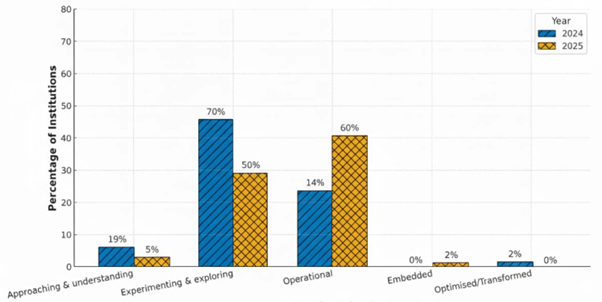
Resource constraints are a challenge and systemic governance gaps remain major barriers. While it is encouraging to note data ethics practices are strong, it is concerning that AI ethics still need development. With regards to innovation, it is thriving in local areas, but enterprise-wide adoption remains a challenge. Psycho-social safety in using AI tools is an acknowledged concern.
Three actions for responsible AI
The Whitepaper calls for three main actions. Firstly, tertiary institutions should operationalise ethical frameworks. While many are developing or have published ethical frameworks, they need to move towards action to safeguard use.
Secondly, the Whitepaper recommends resourcing enterprise-level AI adoption. Institutions would reap significant benefits in investing in this area and moving from an incidental approach to adoption without dedicated resources of time and staffing.
Finally, the findings strongly suggest the need for embedding wellbeing, equity, and accessibility into all AI initiatives. While the AI race is on, we need to remember an inclusive approach will ensure the participation of all staff and students in the journey for good governance.
For more information, please contact the authors or the ACODE Secretariat at [email protected]