The Future of AI Is Being Written. Is Africa Holding the Pen?
Lessons from Geneva by Nancy Muriithi, Globethics Fellow, July 2026.
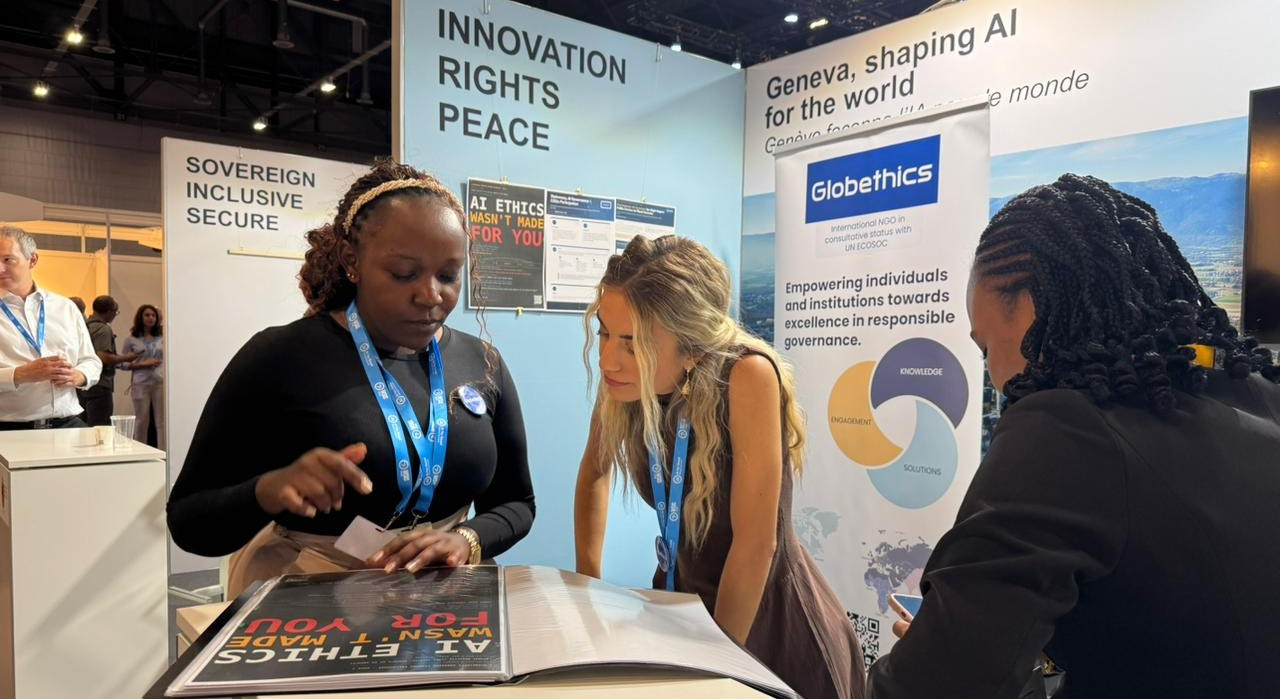
Out of hundreds of speakers, packed conference halls, and robots that seemed to attract more selfies than some of the keynote speakers, what stayed with me most about Geneva Digital Week that the biggest conversation wasn’t really about artificial intelligence. It was about us.
I was in Geneva through the Globethics AI Ethics Fellowship, one of just 15 fellows selected globally. As the fellow from Kenya, I had the opportunity to bring African perspectives into conversations shaping the future of AI governance.
One statistic from the week has stayed with me. Just before the UN AI Dialogue began, the UN’s Independent International Scientific Panel on AI released its first global scientific assessment, concluding that AI capabilities are advancing faster than our ability to understand, evaluate or govern them.
That changes the conversation entirely. Suddenly, governance isn’t about slowing innovation down, it’s about making sure innovation doesn’t leave society behind.
Another key moment was the launch of the second Global Index on Responsible AI. The report found that while almost every government in the world has now made some form of commitment to responsible AI, the average implementation score is just 35 out of 100.
The message was clear: we’re no longer asking whether AI needs governance. Now we’re trying to answer much harder questions:
- How do we govern technology that’s changing every few months?
- How do we write regulations that won’t be obsolete before the ink dries?
- How do we encourage innovation without accidentally creating systems that reinforce bias, erode trust, or widen inequality?
- And perhaps the hardest question of all… Who gets to decide?
And that’s when my mind started wandering home. Not because I was homesick (although, after a few days, I would’ve traded a croissant for a proper Kenyan chapati without thinking twice). But because I kept asking myself one question: Where does Africa fit into all of this?
During the Dialogue, Linda Bonyo, the Founder and CEO of Lawyers Hub, shared something that made me put my pen down. More than half of the world’s conversations on AI governance happen in Geneva. Yet Africa records some of the highest visa refusal rates for people trying to attend them.
I remember thinking… “Well… that’s a bit of a problem.” Because how do you build global AI governance when parts of the world struggle to get into the room?
Those conversations don’t stay in Geneva. They shape the technologies, policies, and systems that affect people's everyday lives. Global conversations quickly become local realities.
The future of AI will be shaped not only by those building the technology, but also by those setting the rules. If African voices are missing from those conversations, whose reality are those rules reflecting?
Geneva also reminded me that context matters. Technology may be global, but it lands in local communities with different cultures, languages, and challenges. Responsible AI isn't about copy-and-paste solutions. It's about understanding people before deploying technology.
One thing I appreciated throughout the week was that Africa wasn't being discussed simply as a market waiting to adopt AI. Across the continent, researchers, startups, and governments are already building solutions, developing strategies, and tackling challenges in ways that reflect local realities.
No, we don't have all the answers. Neither does anyone else. And that's exactly why our perspectives matter.
Looking back, I realised the fellowship wasn't simply about travelling to Geneva. It was about ensuring African voices can contribute while these conversations are still taking shape, not after decisions have already been made.
Because if AI is going to shape everyone’s future, then everyone deserves a say in how that future is governed. Not because we’re asking for a seat at the table. But because the table is incomplete without us.
The future of AI isn't something that will happen to Africa. It's something Africa can, and must, help shape. That's why we need to be in the room, asking difficult questions, building solutions, and challenging assumptions. That's how better technology gets built.
As for me? I came home with more questions than answers… and somehow, I think that’s exactly the point.
Read the full article here: The Future of AI Is Being Written. Is Africa Holding the Pen? Lessons from Geneva