
Changing Narratives, Increasing Visibility: The G20 Interfaith Forum Navigates Today’s Polycrises
Katherine Marshall, G20 Interfaith Vice President; Chair, Policy & Networking Committee, March 2026.
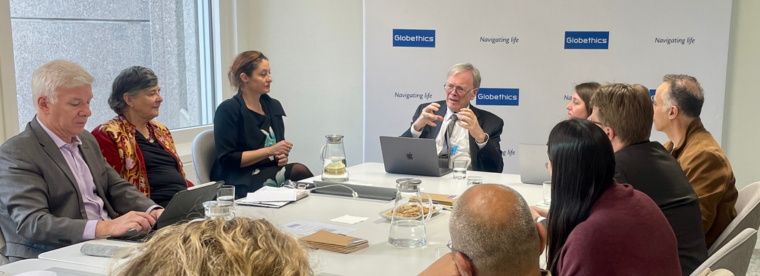
As the US‑Israel‑Iran war intensified the vertigo caused by global polycrises, Arigatou International and other colleagues organized a March 5 meeting at Globethics, focused on G20 agendas for 2026 and 2027. The backdrop was threats to core institutions focused on development and humanitarian support; the core question was how notions of “religious social responsibility,” alongside the United Nations Sustainable Development Goals (SDGs) and “corporate social responsibility,” could and should contribute to urgently needed rethinking and revamping of global agendas. How, the meeting asked, can interfaith actors and the G20 Interfaith Forum (IF20) play more strategic roles, especially through the G20 process?
IF20 works to contribute substantively to policy discussions, advancing proposals that draw on pertinent religious experience and teachings. IF20 has served since 2014 as a “network of networks,” amplifying the contributions of religious communities, scholars, and civil society actors and linking diverse actors with development, peace, and humanitarian action at their core. Immediate challenges are moving collective religious voices beyond symbolic participation, strengthening mechanisms of collaboration and influence, and communicating better the extensive and pertinent experience in religious communities.
In today’s admittedly difficult environment, with regressive agendas in many world regions and declining trust in democratic institutions, the Geneva discussion highlighted urgent needs for constructive and principled engagement on wide‑ranging issues. The US government’s 2026 G20 agenda explicitly downplays topics that faith communities have traditionally emphasized: equity, sustainability, social justice, and climate change. Even so, official agendas focused on economic growth, energy security, and technology and AI (plus trade) allow space for significant engagement. But issues that the IF20 has addressed over the years — notably human trafficking, corruption, food and hunger, debt relief, children and education, and women’s roles — demand attention and action.
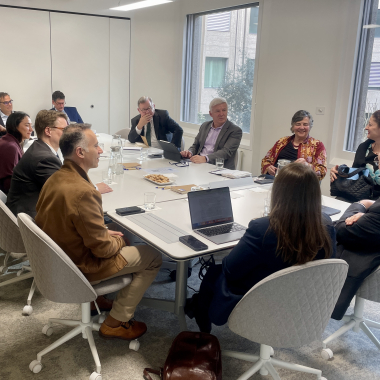
More demanding still, breakdowns in international legal frameworks, norms, and institutional capacity — even the very principles underpinning multilateral cooperation — demand deeply rooted rethinking and new approaches, from political and socio‑economic to day‑to‑day practice. As humanitarian and development institutions and faith‑based and faith‑inspired organizations respond to enormous social challenges and broad agendas with less funding, it is simply not enough to swallow and agree to “do more with less.”
Grave shortfalls in progress towards the Sustainable Development Goals (SDGs) underscore the need to go to the roots of problems with fresh thinking that sticks to values and goals that, like the wheel, still work well, but look well beyond today’s assumptions and tools.
Broadening traditional alliances and partnerships is a must. Influence today goes far beyond governments: financial institutions, technology companies, major corporations, global investors, and philanthropic actors play decisive roles, with many individuals within these sectors motivated by ethical and faith‑informed values. Interfaith networks can have more impact by engaging wider networks more intentionally. Bridges among faith communities and economic decision‑makers can reflect experience in more structured ways, within but also beyond the constraints of formal political spaces.
Telling stories better is far more critical than many recognize. The full scope of faith‑inspired engagement rarely reaches political decision‑makers in effective ways, so stronger and more strategic and agile communications, bolstered by ethical framing and concrete examples of what works, are essential. Perspectives of young people and women, despite distinctive challenges in a religious context, enrich the story. Avoiding the traps of “no action, talk only” (some abbreviate it as “NATO”), creative action and collaborative results can move us forward.
IF20 aims to bridge local inspiration and initiative and broader agendas. As religious actors highlight ethical reflection and community knowledge in global governance debates, their roles, especially in today’s fragmented geopolitical environment, can heal and forge new links. Deeper strategic thinking, broader alliances with influential actors, and stronger communication that unpacks faith‑inspired wisdom, experience, and language in policy‑relevant language and frameworks can help.
Engaging faith communities on global development agendas is not optional. The question is how they can contribute more deliberately and effectively to policies that foster accelerated action to address inequalities and injustices with more sustainable and inclusive models of development. As the SDG 2030 deadline fast approaches, reflections on next steps will hopefully engage faith communities far better and more explicitly. Radical rethinking is essential here, setting aside lingering confidence in “business as usual.” New forms of communications and different and broader alliances are essential, as is strengthened collaboration across networks. But most important is a vibrant commitment to the core values, practices, and institutions that, like wheels, endure because they reflect what is essential for human flourishing and to a collective, sincere global commitment to equity. Our goal is better solutions for all that reflect the financial resources, human capital, and reach of religious communities, especially their ability to mobilize networks, engage across sectors, and respond at scale to communities. IF20, and the labyrinth of networks whose wisdom and experience it draws upon, have critical and demanding responsibilities and roles to play.
🔗 Read the extended version of this reflection
These reflections strongly align with Globethics’ “Towards a Global Alliance for Peace” initiative, which drives global conversation about inclusive peace and ethical leadership in international cooperation. These insights are captured in the White Paper Changing the Narrative: Preparing for Peace.