
Women in Tech Summit 2026: Ethics Needs Wi‑Fi
R. Kat Morse, Acting Head of Solutions Hub, May 2026.
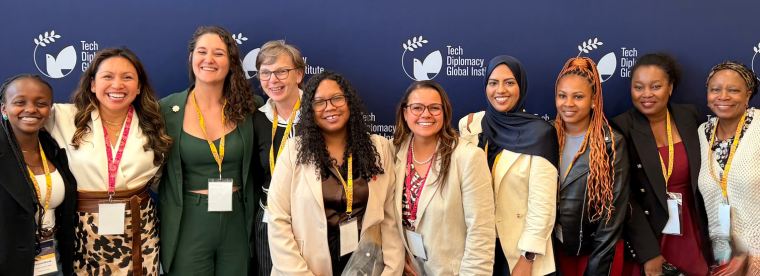
Women in Tech Summit 2026 summed up (for me): Ethics needs Wi-Fi.
The Women in Tech Summit 2026 brought together conversations on AI, governance, leadership, and the future of technology. These discussions highlighted not only technical progress, but also the growing importance of AI ethics, inclusive AI, and ensuring broader participation in shaping digital systems.
One moment that stood out for me was Carina Bruwer's keynote (also, the first time I have cried at a conference). My takeaway was that discipline matters; preparation, practice, and structure all matter. But at the same time, there comes a point where structure gives way to authenticity. Continuing despite uncertainty, fatigue, or not knowing the next step felt like a useful way to think about leadership, particularly in fast-evolving fields like AI.
Across the summit, it was clear that women are already contributing to the technology sector in meaningful ways. Discussions around women in AI reflected this reality: women are building, questioning, and leading, often in environments where they are still underrepresented and underestimated.
This raises an important question: not whether women belong in tech, but whether they have real power in shaping it. This includes influence over governance, system design, data use, and decisions about who benefits from AI systems. These are ultimately questions of responsible governance and accountability in emerging technologies.
One shift in perspective for me was thinking about AI bias not only as a technical challenge, but also as an issue of access and power. Limited connectivity, particularly for women in the Global South, restricts opportunities to engage with and evaluate the tools that are supposedly shaping the future. Without participation, inclusive AI cannot be achieved, and existing biases get deeper.
Similarly, when data is collected without meaningful involvement from the individuals it represents, people risk being positioned not as contributors but as inputs. This highlights the importance of agency within AI ethics and the need for more inclusive approaches to data and design.
Amy Karle's keynote reinforced the idea that individuals are not just users of technology, but can also be active contributors to it. However, this depends on whether there are real opportunities to participate. Ethical decision-making in AI requires diverse perspectives, as well as the infrastructure and access needed to support them.
From a Globethics perspective, these discussions point to the need to move beyond conversation toward implementation. Strengthening responsible governance, supporting practical approaches to ethical decision-making, and developing tools that enable more inclusive AI systems are all essential steps.
Women are already part of the AI and technology landscape. The question now is how institutions, organisations, and policymakers will support greater access, participation, and influence—ensuring that the future of AI reflects a broader range of voices and experiences.