
Why Human Flourishing Should Replace GDP as the Metric for Success
Biddie Clive, Globethics Communications Intern and Colgate University student, April 2026.

For more than half a century, we have treated Gross Domestic Product (GDP) as the scoreboard of societal success: if GDP rises, progress is assumed; if it falls, alarm bells ring. But even as economies expand, people across the globe report rising anxiety, loneliness, and a growing sense that something essential is missing.
New research suggests that we should shift our perspective, revealing why GDP was never the right metric to begin with.
In April 2025, Harvard and Baylor Universities collaborated to release the Global Flourishing Study (GFS), one of the largest, most comprehensive investigations of human well-being. Published in Nature Mental Health and supported by over 200,000 participants across 22 countries, the study offers a rigorous alternative to strictly economic definitions of progress—and a clearer perspective on the critical question: What does a good life actually require?
The answer, as the study grounds in data rather than aspiration, is human flourishing.
What Is Human Flourishing?
The Global Flourishing Study examines human flourishing under the working definition: “Relative attainment of a state in which all aspects of a person’s life are good, including the contexts in which that person lives.”
This definition acknowledges that flourishing is explicitly multidimensional and that individual well-being cannot be separated from social, economic, and institutional environments.
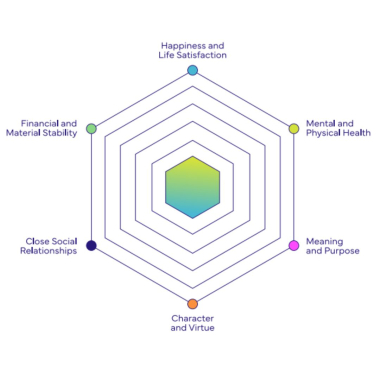
The GFS operationalises this idea through six measurable domains, consistently valued across cultures:
- Happiness and life satisfaction
- Mental and physical health
- Meaning and purpose
- Character and virtue
- Close social relationships
- Material and financial stability
The first five domains are understood as ends in themselves—elements people seek because they are intrinsically valuable—but financial stability, while essential, is framed as foundational rather than ultimate: it supports flourishing but does not define it.
From “Soft” Values to Hard Measurement
The Global Flourishing Study confronts scepticism towards terms like purpose, character, or community as subjective or culturally relative. Using nationally representative samples and psychometrics, the study demonstrates that these domains can be reliably measured, compared across countries, and tracked over time. The Flourishing Index, a composite metric analysed with participant demographics and childhood experiences, quantifies how well lives are actually going—not just economically, but humanly—and how the participants view their own flourishing.
Crucially, the study is longitudinal, meaning it follows the same individuals over multiple years. This allows researchers to examine how life conditions, institutions, and experiences shape flourishing over time.
Through these measures, the GFS asserts flourishing not as a vague moral vision but as an empirical construct.
What the Data Reveals
The Global Flourishing Study’s expansive geographic and cultural reach moves the conversation beyond Western assumptions about well-being. Patterns across countries suggest that flourishing is closely linked to:
- Strong social relationships
- A sense of meaning and purpose
- Physical and mental health
- Adequate financial security
One striking pattern already emerging from early waves of data indicates that, for ages 18–49, “flourishing is essentially flat” and “increases with age thereafter,” challenging assumptions of a U-shaped relationship between age and life satisfaction. Although this finding is not entirely universal, the overall global pattern that “young people are struggling” is troubling.
Other patterns vary by national context, reminding policymakers that flourishing is shaped by culture, institutions, and history—not universal policy templates.
From Measurement to Governance
Perhaps the most powerful contribution of this research is that it turns moral language into governance targets. The conditions GFS identifies do not emerge spontaneously from markets alone; rather, they are shaped by policy choices, organisational norms, and leadership priorities.
This is the bridge from research to responsible governance; from data to ethical leadership frameworks that treat human flourishing as the outcome, not a side effect.
GDP may still tell us how much is produced, but flourishing tells us whether that production adequately serves human life.
Effective leadership is no longer just about efficiency or growth, but about creating the conditions under which people can live good lives—ethically, sustainably, and globally.
Why Leaders Should Care
The Global Flourishing Study does not claim to offer a utopia. Flourishing, by definition, is an ideal—never perfectly attained. However, it does offer a shared language, grounded in evidence, for rethinking what success and progress mean.
For leaders in business, government, and civil society, the message is clear: If progress does not advance human flourishing, it is not real progress. With the GFS, we can now measure the difference.
What We Can Do
Looking ahead to the Global Ethics Forum 2026 in Bali, Indonesia, we are taking the opportunity and responsibility to reimagine human flourishing at both individual and global levels — with a special focus on youth — addressing pressing challenges while shaping pathways toward greater societal wellbeing. More information and registration for GEF2026 coming soon.