
Before the tool: what Geneva Peace Forum 2026 taught us about responsible AI
Globethics at Geneva Peace Forum 2026, our fourth consecutive year hosting a session at the Forum.
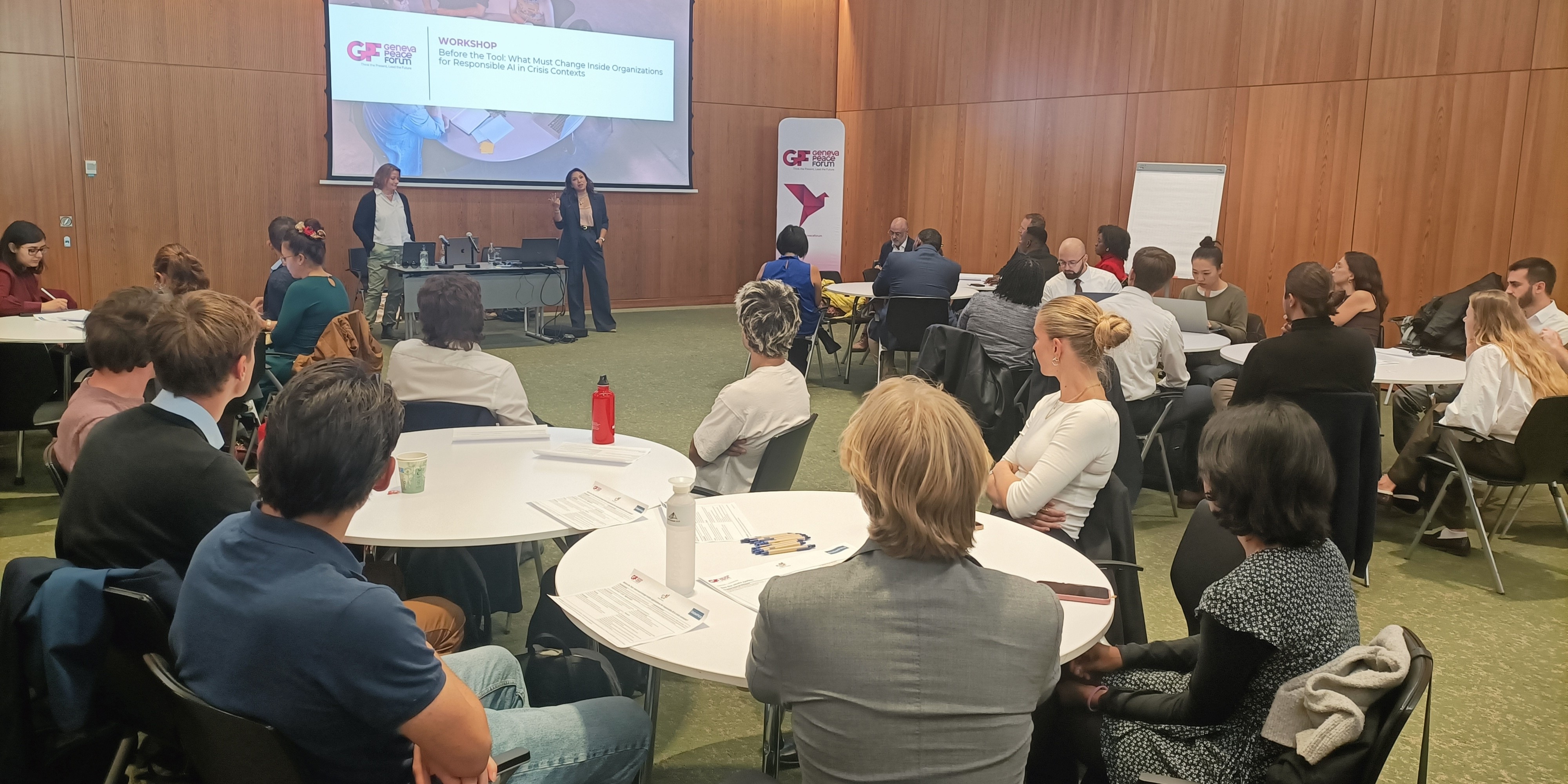
This October, Globethics returned to the Geneva Peace Forum for the fourth year running. Our sessions, focused on responsible AI, were interactive, intentionally giving participants practical experience of tools and frameworks to use in their work. We joined a panel on AI for humanitarian and peacebuilding organisations and hosted a workshop on responsible AI in crisis contexts. Both pointed to the same conclusion: for most organisations the hard part of responsible AI is internal, and civil society must be in the room where it is governed.
What we heard on the panel
On the panel (AI for Peace: Empowering Humanitarian and Peacebuilding Organizations through Responsible Technology), senior practitioners were not asking whether AI matters. They were working through security, ethics, quality, governance and trust.
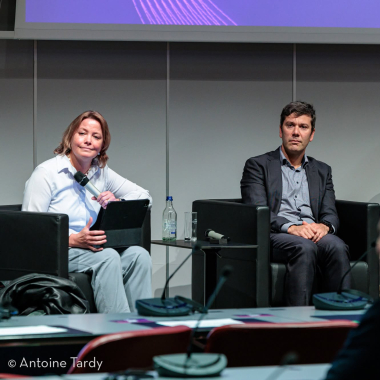
Kevin Osborne, who joined Susan Wilding (Collective Intelligence for Good); Cecilia Cannon (Polisync) and Anne-Marie Buzatu (ICT4Peace Foundation) on the panel, shared his key takeaway: people are using AI and thinking about the risks, but not yet systematically enough. The data agrees. In a January 2026 survey of 1,729 humanitarian practitioners, 75% used AI daily or weekly, yet only 23% had a formal AI policy and 9% worked where AI was widely integrated. Civil society organisations need practical support to move from experimenting to responsible adoption.
Why civil society must be at the table
Civil society organisations work closest to affected communities. They hold sensitive data and carry people's trust, yet often have the least capacity to assess a new tool. The same survey found formal AI policies in just 13% of local organisations, against 39% of UN agencies. Without them, governance reflects the priorities of larger institutions and vendors.
Workshop participants raised data security, data sovereignty, vendor lock-in, biased training data and the digital divide. That divide is wide: 2.2 billion people remain offline, 96% of them in low- and middle-income countries. Anne-Marie Buzatu of the ICT4Peace Foundation stressed that trust with the people you serve is foundational, and that explainability matters most where digital literacy is limited.
Geneva's role in AI governance
Geneva is the right place for these conversations because the people who need to be in them are already here: 43 international organisations, 184 permanent missions and 750 NGOs, according to a 2025 Geneva Graduate Institute study of the city's role in AI governance, supported by Microsoft. The same research found gaps: few technology companies are active in Geneva beyond Microsoft, and financial barriers prevent equal Global South participation in Geneva-based discussions.
That makes civil society's role more important, not less. Geneva hosts the Geneva AI Summit in June 2027, and as part of the Road to Geneva pre-events (including Global Ethics Forum 2026), Globethics is working to widen civil society's involvement on that road, so that those closest to affected communities help shape what the Summit takes up.
The workshop: Before the Tool
Kat Morse, Acting Head of Solutions Hub at Globethics, led the session Before the Tool: What Must Change Inside Organizations for Responsible AI in Crisis Contexts with Anne-Marie Buzatu, using the WISE canvas, Globethics' decision-making framework.
Kat's starting point: responsible AI begins before deployment, in internal discussions rather than the policy document. Leadership wants speed, legal wants less risk, governance wants to pause and staff want clarity. AI sharpens those tensions. What breaks first is usually governance: ownership, escalation, and willingness to admit uncertainty and pause. An AI-ready organisation needs transparency, accountability and adaptability.
Case study: Signal Lost
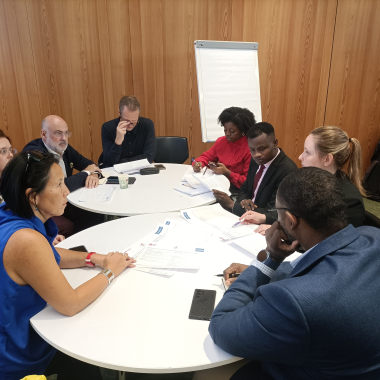
Groups tackled a fictional scenario. Relief Bridge International, a humanitarian NGO, uses an AI triage tool to prioritise displaced families. High-risk families are being ranked lower, a journalist is asking questions, and the provider reports no confirmed defect. Each table acted as the executive committee, with 72 hours to decide.
Three of four tables paused the tool, in full or in part. One wanted to verify the problem first. All named the same trade-off: speed of help against the risk of getting it wrong.
Their proposed structural fixes were consistent:
- Mandatory human validation, with no fully automated decisions
- Regular, independent audits
- Clear ownership, with the board accountable for outcomes
- Field teams in governance, diverse data, and AI literacy training across the organisation
None of these are technical fixes. They are decisions about who is responsible and who can stop a tool.
As the road to the Geneva AI Summit in June 2027 continues, Globethics will keep working to bring civil society into these conversations. Our WISE framework gives organisations a practical way to start, before the tool arrives. To use the canvas, or to talk about support for your organisation, contact us.